

Tungustic Language
in Manchu language : gurun = Country/ suwayan = yellow/ anggiyan =white/ fulgiyan =red/lamun = blue/ 愛新= aisin = gold
As mentioned above Manchu is an agglutinative language, and its basic sentence structure is Subject-Object-Verb (SOV).
Nouns in Manchu have a number of cases which are determined by suffixes:
- nominative - used to mark the subject of a sentence, it is marked by no suffix.
- accusative - used for the direct object of a sentence, it is marked by the suffix -be.
- genitive - used to indicate possession and means by which something is accomplished, it is marked by the suffix -i or the particle ni if coming after a word ending in -ng. For instance, wang ni moo (the king's tree).
- dative/locative - used to indicate location, time or place, or indirect object, it is marked by the suffix -de.
- ablative - used to indicate the origin of an action or in a comparison, it is marked by the suffix -ci.
Selection of Jurchen words
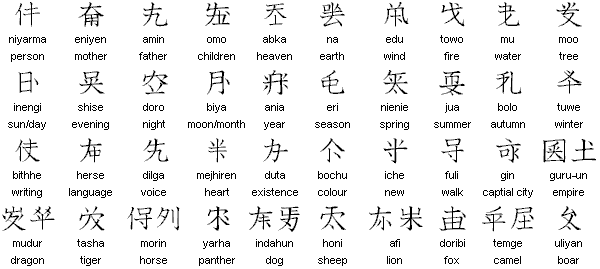
fan/fanju= inquiry
ese = these
jau = provnce
se = inkstone
giya = street
giyen = during (period lasting)
nihiya = moment
yu = bed
da = provide
nushi = peace
jho = left
ili = stand
jhili = sparrow
niru = arrow
tuwe/towo = fire
ir = hair
yen = banquet
erin = season
songi = nose
shinko = hawk
hehe = female
fuli = command
ali = mountain
uri , uli = north
giru = shame
jhuwi = child
tire = pillow
tiko = fowl
etu =wear
jhashi = information
san = white
sa =know
tuwan =look
lefu =bear
tedu =sleep
duli =middle
bulun =mirror
tun =through
gula = shoe close to くつ and 구두
amu = amu = back?!!?
te =
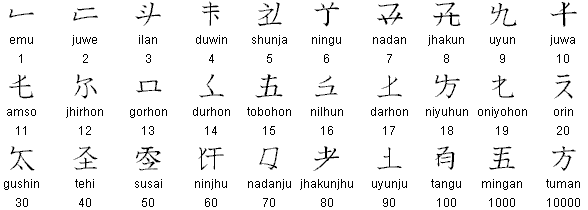
Jurchen numbers
South Tungustic = Fuyu language: Koguryoic, Paekche, Kayan and Japonic/Yamato languages
hito; futa; mitsu ; yon; itsu; mutsu; nana; yatsu ;kokono ;tô
OKog
mir 「밀(密)」 (SS) three : OJpn mi id.OKog nanun 「난은(難隱)」OJpn nana id.
OKog ütsi (KS) five : OJpn itu id.
OKog ku (SS) child : OJpn k ú (Martin 1987: 452: *kwo) > NJ ko id.
OKog kìr ~ key tree, wood : OJpn kì ~ ki id.
AKog gapma (SKC) great mountain ~ OKog §ap high mountain : OJpn yama mountainAKog
kuru (SKC) walled city, fort ~ OKog ku ër id. : OJpn kì id.AKog
kweyru (HHS) yellow ~ OKog ku ër id. : OJpn ki, ku- ~ k ú- id. OKog kìr tree, wood ~ OKog (dial.) key id. (SS) : OJpn kì ~ ki id.OKog
ku ërtsi mouth ~ OKog (dial.) k útsi (SS) < *kutui id. : OJpn kuti < *kutui id.OKog
puk deep(SS) : OJpn puka- id. : EMK kiph uÿnOKog
piar level, flat (SS) : OJpn pira- id. : EMK y oÿth oÿ/ny oÿth oÿ/yath uÿnOKog
tan valley (SS) : OJpn tani id. : EMK kolk oÿiSource Abbreviations
HHS: Hou Han shu
; KS: Kory o Sa; SKC: San kuo chi; SS: Samguk Sagi.ancient Koguryo kingdom, or Archaic Koguryoÿ (AKog),
toponyms from north of the Yalu
medieval Kogury
o kingdom, or Old Koguryoÿ (OKog)toponyms from the central Korean Peninsula
A possible extinct language of Korea. Since it is known only from approximately thirteen placename glosses, evidence for this language is scant, and its existence is suspect. What evidence there is looks Japonic, but it is not known whether these placenames reflect the language of the Kara tribal confederation, or possibly some more earlier stage.
An extinct language of Central Asia. 916 - 1125 AD.
Koguryoic/Koguryoan/Old Koguryo :
A possible language once spoken in NE China (Liaoning), Manchuria, and Korea, 1st century to mid-8th century A.D. The earliest solid historical reference to the Koguryo people (1st century A.D.) has them in the Liao-hsi area (now part of Liaoning province, northeast of Tientsin) of China. The evidence for this language lies almost solely in toponyms rather than texts, and is thus unreliable. The Archaic Koguryo corpus dates to the third and fourth century A.D. and consists of about a dozen identifiable lexemes recorded in Chinese historical and geographical accounts of the Koguryo kingdom. The Old Koguryo corpus, largely dating to the seventh and eighth centuries, consists of over a hundred lexemes found in the form of glossed toponyms, plus a small number of words recorded in Chinese historical and geographical accounts. The language, if real, may be related to Japanese. After the conquest of the Koguryo kingdom in 668 A.D., its inhabitants were partly dispersed deep within the territory of T'ang China and partly gradually absorbed by Silla Korean speakers. The most extensive body of data on the language was recorded in the mid-eighth century when the former Koguryo place names were changed to Chinese names.(Information provided by Christopher Beckwith and Sasha Vovin)
A possible extinct language or dialect spoken in the eastern Korean peninsula north of Silla (which kingdom was for centuries limited to the SE corner of the peninsula), it was absorbed by Koguryo some time before the demise of the Koguryo kingdom. The evidence for this language is scant, since it is based on toponyms, and the existence of the language is questionable. The Koguryo themselves are also sometimes called Maek in Chinese sources. The name Maek is attested as the name of a foreign people to the NE of China in high antiquity, and the identifications with the ancient people may be ahistorical.
Middle Korean lasted from the beginning of the Koryo period (918 - 1392) until the Imjin Wars (the Japanese invasion) of 1592. Middle Korean is further divided into Early Middle Korean and Late Middle Korean. Early Middle Korean lasted from the beginning of Koryo until around the founding of the Choson dynasty [in 1392]. Late Middle Korean was the language represented in the earliest alphabetic texts in Korea, those of the fifteenth and sixteenth centuries. Tenth century to the end of the sixteenth century. (Information provided by S. Robert Ramsey)
A language of Japan. The ancestor of modern Japanese. 7th-10th centuries AD.
The ancestor of modern Korean. This stage extends from the Three Kingdoms period until the end of Unified Silla in the tenth century, a period of time lasting about 1,000 years. The term "Old Korean" is often used to refer to three distinct languages spoken on the Korean peninsula, Koguryoan, Paekchean, and Sillan, of which Sillan is thought to be the immediate ancestor of Middle Korean, and thus of Modern Korean. The kingdom of Koguryo is said to have lasted from 37 B.C. to A.D. 668; Paekche from 18 B.C. to A.D. 660; and Silla from 57 B.C. to A.D. 935. (Information provided by S. Samuel Ramsay)
Alternate Names :Shilla ; Silla ; Sillan
A possible ancient language of Korea. The evidence is very scant, and it is not clear that what evidence there exists even comes from the same language. 5th to 7th centuries AD.
An extinct language once spoken in Manchuria. Little is known about Puyo except that it and Koguryo were evidently mutually intelligible, according to Chinese accounts (also, the two peoples shared the same foundation myth). This is confirmed by the few attested Puyo words, which are virtually identical to their Koguryo cognates (for example, Puyo and Koguryo *ka head of a clan, chief, minister, *key king). The Puyo language or dialect was spoken in Manchuria north of Koguryo territory. (Information provided by Christopher Beckwith)
A possible extinct language once spoken in NE China (Liaoning) and SW Korea. The corpus of potential Paekche material is very difficult to interpret, and the evidence for the language is thus very problematic. The founders of the Paekche kingdom of Korea were a branch of the Puyo (and perhaps had the same foundation myth as the Puyo and Koguryo peoples). There were possibly two languages spoken in Paekche from then until its conquest in the mid-seventh century, one being Puyo-Paekche (the language of the ruling class), the other Han-Paekche ('Han' referring to the apparently autochthonous non-Puyo-Koguryoic languages; Korean is a Han language).
From Sillan and SamHan languages => Korean
하나/한/하루; 둘/두/이틀;셋/세/사흘; 넷/네/나흘; 다섯/닷새; 여섯/엿새; 일곱/이레; 여덟/여드레 ; 아홉/아흐레; 열/열흘;
스물 ;서른 ;마흔 ;쉰 ;예순;일흔 ;여든 ;아흔
알타이 조어
터키 · 몽고 · 퉁구스 공통어 => 원시 터키어 => 터키어
=> 몽고·퉁구스 공통어 => 몽고어 ; Khitan
만주어
부여 한조어 = 원시 부여어 북방계(系)=> 고구려어
夫餘 韓祖語 原始 夫餘語 => 高句麗語
퉁구스어
Old Japanese => Japonic languages =>일본어
=> 백제어 (?)
百濟語
원시 한어 남방계=> 신라어 => 중세한국어 => Modern Korean
原始 韓어=> 新羅語 => 中世韓國語
Sources:
http://www.omniglot.com/writing/jurchen.htm
http://www.omniglot.com/writing/manchu.htm
http://www.msu.edu/~jk13/Abs.Beckwith.pdf
http://linguistlist.org/forms/langs/GetListOfAncientLgs.html
http://www.chosun.ac.kr/~ongmi/teaching/korhistory/kh4-5.htm
http://www.chosun.ac.kr/~ongmi/teaching/korhistory/kh4.htm
http://www.koreandb.net/dictionaries/Viewframe.aspx?id=3019&ser=2
http://midkorea.netian.com/midkor/mast/korslanguage.htm
http://ulsan.kbs.co.kr/bbs/ezboard.cgi?db=k_ulsancol4&action=read&dbf=68&page=0&depth=1
고구려 = 홀(忽,Khor)·골 (Kor)·구루(溝鷺, Kuru)???? in koguyo language?
http://chang256.new21.net/board/board.php?db=536&no=579
Paekche = Kudara in Japanese (= HyaKu D/Nara???)